

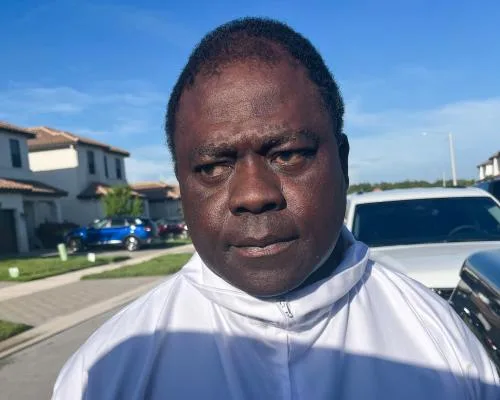
The trial of a Roman Catholic priest, Anthony Odiong, who's accused of sexually abusing female congregants, has begun in Texas. Odiong, 57, faces five counts of sexual assault in the first degree and two counts in the second degree, which could result in life imprisonment if he's convicted.
What's even more shocking is that the charges against Odiong were prompted by a report from the Guardian about women who accused him of sexual coercion, unwanted touching, and abusive financial control. This report was published in February 2024. A woman subsequently brought a copy of the story to the Waco police, revealing that Odiong had allegedly sexually assaulted her in 2012.
Odiong, who was ordained as a priest in Nigeria in 1993, had worked in various roles, including as a pastor of a church in West, Texas, and in campus ministry at Baylor University in Waco. His main role was to be the pastor of St Anthony of Padua church in Luling, Louisiana, where he also built a healing chapel next to the church after reportedly raising $600,000.
Waco prosecutors contend that Odiong's having more than four accusers allows them to legally charge him with some of his alleged crimes, no matter how much time had passed since they occurred. The trial is expected to last a week or more. Prosecutors are set to call a number of accusers as witnesses and present evidence that Odiong fathered at least one child with a woman who had been a congregant of his.
Odiong had been suspended from ministry in Austin in 2019 over allegations of misconduct with multiple women. However, he wasn't suspended from the ministry in New Orleans until December 2023, despite church officials in Austin notifying their counterparts in New Orleans about the allegations. The archdiocese at the time cited misconduct with multiple women without revealing that they had been notified of the alleged behavior by diocesan officials in Austin at least four years earlier.
This has raised questions about how the Catholic church handles allegations of misconduct and abuse within its ranks. The church's handling of these allegations is under scrutiny. It's clear that the church didn't take immediate action against Odiong, despite being notified of the allegations.
As for the trial, it started late Tuesday morning with the prosecution and the defense beginning to question a pool of 100 prospective jurors. The Texas state judge presiding over the case, Thomas West, denied a motion to postpone Odiong's trial. He also denied another motion to prohibit evidence derived from Odiong's arrest on allegations of possessing illicit digital images of a disrobed child.
The images were found as investigators looked into the complaint against him prompted by the Guardian's reporting. Odiong's attorney, Gerald Villarial, argued that a congregant had sent the images to the clergyman to display a girl's skin irritations and a possible rash. The parishioner asked Odiong to pray for the child's healing.
Authorities argued that the child fathered by Odiong was living proof that he had a pattern of pursuing female congregants. The child's mother is not one of the three women Odiong was charged with clerically abusing. This evidence is significant because it shows a pattern of behavior.
The trial will continue, with prosecutors set to present their case against Odiong. If convicted, he faces life imprisonment, which would send a strong message about the consequences of abusing one's power and position. It's a serious conviction that would reflect the severity of the crimes.
Key Facts
- Anthony Odiong, 57, is on trial for five counts of sexual assault in the first degree and two counts in the second degree.
- The charges were prompted by a report from the Guardian about women who accused him of sexual coercion and abuse.
- Odiong was ordained as a priest in Nigeria in 1993 and had worked in various roles in Texas and Louisiana.
- He faces life imprisonment if convicted of any of the first-degree charges.
- The trial is expected to last a week or more, with prosecutors set to call a number of accusers as witnesses.
As the trial continues, it's clear that the case against Anthony Odiong is complex and multifaceted. The outcome will depend on the evidence presented and the verdict of the jury. The case has brought attention to the issue of abuse within the Catholic church and the need for greater accountability and transparency. This attention is crucial for creating change.
The case also raises questions about the Catholic church's definition of a vulnerable adult in the context of clergy abuse. Currently, the church only considers a vulnerable adult to be someone who is older than 18 and has severe intellectual, developmental, or psychological disabilities. There is a growing debate within the church about whether to widen this definition to include those who are under the spiritual authority of priests and then targeted for sexual contact by the clerics. This debate is important for protecting vulnerable adults.
The archdiocese of New Orleans, where Odiong worked, has recently agreed to pay $305m to abuse survivors to settle a bankruptcy protection case. The case was filed amid the financial fallout of the global church's enduring clerical molestation scandal. This settlement provides justice and compensation to the survivors of abuse. It's a step towards healing and recovery.
The settlement highlights the need for greater accountability and transparency within the Catholic church. The church must take steps to prevent abuse and support survivors. It's a significant step towards providing justice and compensation to the survivors of abuse, as it acknowledges the harm caused and provides financial support.
In the end, the trial of Anthony Odiong will be a significant test of the Catholic church's commitment to addressing abuse and promoting accountability. The outcome will have far-reaching implications for the church and its members. It will likely shape the conversation about abuse and accountability for years to come. The church's response to the trial will be closely watched, and it's expected to have a lasting impact on the church's policies and procedures.