

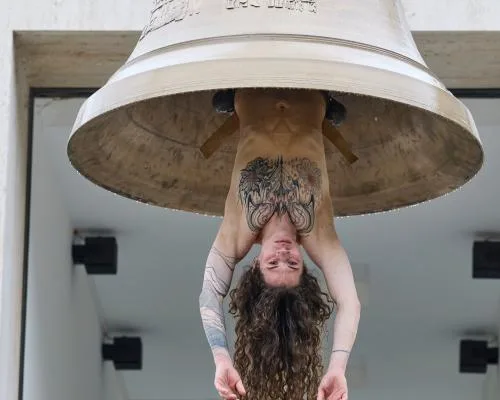
The 2026 Venice Biennale has officially kicked off, and it's already making waves in the art world. One of the most talked-about installations is Florentina Holzinger's Austrian pavilion, which features a post-apocalyptic scene with a woman riding a speedboat in circles, two others suspended at the top of a pole, and another sitting entirely submerged in a tank. But what's really got people talking is the fact that none of the performers are wearing any clothes. Viewers are even invited to use two toilets so that their urine can be purified and pumped into the tank - a move that's raised some eyebrows.
But Holzinger's pavilion is just one of many thought-provoking installations on display. Sanya Kantarovsky's eerie seances, which feature paintings that are like stills from intense films, are another highlight of the exhibition. His work is displayed in book-lined rooms with incredible Murano glass chandeliers, and the show culminates with an incredibly detailed sculpture of the head of a boy, also in Murano glass. The atmosphere is like a weird seance between the centuries.
The biennale has also been marred by controversy, with the South African government banning artist Gabrielle Goliath from appearing at the event. Her piece, called Elegy, is a tribute to a Palestinian poet, and was deemed "highly divisive" by the government. But Goliath has staged the work anyway, in partnership with London arts centre Ibraaz, at the Chiesa di Sant'Antonin. The performance itself is hypnotic, as screens show operatically trained female performers holding a single high note. Then, as their voice fades, they step down from a platform and are replaced by another singer.
The biennale has a long history of showcasing innovative and provocative art, and this year's exhibition is no exception. With its mix of established and emerging artists, the biennale is a must-see for anyone interested in contemporary art. But it's not just the art that's making headlines - the biennale has also been the subject of controversy and debate.
Key Facts
- The 2026 Venice Biennale is currently underway
- Florentina Holzinger's Austrian pavilion features a post-apocalyptic scene with nude performers
- Sanya Kantarovsky's eerie seances feature paintings that are like stills from intense films
- Gabrielle Goliath's piece, Elegy, is a tribute to a Palestinian poet and was banned by the South African government
- The biennale features a mix of established and emerging artists
- The exhibition includes installations by Carrie Schneider, Lydia Ourahmane, and Lawrence Abu Hamdan
- The biennale is being held in various locations throughout Venice, including the Giardini and Arsenale
The Artists
The biennale features a diverse range of artists, from established names like Sanya Kantarovsky to emerging talents like Carrie Schneider. Kantarovsky's work is known for its intensity and emotional depth, and his paintings are like stills from very intense films. Schneider, on the other hand, is a photographer who has gained recognition for her innovative use of the medium. Her 1.5km-long photographic curls, which repeat over and over a still from Chris Marker's 1962 film La Jetée, are a highlight of the exhibition.
But the biennale isn't just about showcasing established artists - it's also a platform for emerging talents to gain recognition. Artists like Lydia Ourahmane and Lawrence Abu Hamdan are using the biennale to showcase their work and gain international recognition. Ourahmane's delicate sculptural show, which features components drawn entirely from the city of Venice, is a touching and thoughtful piece that works with, rather than against, the grain of the world.
The biennale has a long history of supporting emerging artists, and this year's exhibition is no exception. With its mix of established and emerging artists, the biennale is a must-see for anyone interested in contemporary art.
The Controversy
The biennale has been marred by controversy, with the South African government banning artist Gabrielle Goliath from appearing at the event. Her piece, called Elegy, is a tribute to a Palestinian poet, and was deemed "highly divisive" by the government. But Goliath has staged the work anyway, in partnership with London arts centre Ibraaz, at the Chiesa di Sant'Antonin.
"I was surprised by the government's decision to ban me from the biennale," Goliath said in an interview. "But I'm not going to let it stop me from showcasing my work. I believe that art has the power to bring people together and spark important conversations."
The controversy surrounding Goliath's piece has sparked debate about the role of art in society. Should artists be free to express themselves without fear of censorship, or do they have a responsibility to consider the impact of their work on others? The biennale has always been a platform for artists to push boundaries and challenge societal norms, and this year's exhibition is no exception.
The Locations
The biennale is being held in various locations throughout Venice, including the Giardini and Arsenale. The Giardini is a beautiful park that's home to several national pavilions, each featuring the work of artists from a specific country. The Arsenale, on the other hand, is a vast, cavernous space that's been converted into a gallery.
The locations of the biennale are an integral part of the exhibition, with many artists creating site-specific works that respond to the unique architecture and history of the venues. The Giardini, for example, is a beautiful park that's been transformed into a giant art gallery, with pavilions and installations scattered throughout. The Arsenale, on the other hand, is a vast, industrial space that's been converted into a gallery, with artists using the space to create large-scale installations and performances.
The biennale's use of non-traditional venues is one of its strengths, allowing artists to push the boundaries of what's possible and create innovative and provocative works. Whether it's the beautiful park of the Giardini or the industrial space of the Arsenale, each location provides a unique backdrop for the art on display.
The History
The Venice Biennale has a long history of showcasing innovative and provocative art, dating back to its founding in 1895. The biennale was established as a way to promote the arts and provide a platform for artists to showcase their work, and it's since become one of the most prestigious art exhibitions in the world.
Over the years, the biennale has played host to some of the most important and influential artists of the 20th century, including Pablo Picasso, Salvador Dali, and Jackson Pollock. The biennale has also been the site of many iconic performances and installations, from Marina Abramovic's groundbreaking performance art to Carsten Höller's interactive installations.
The biennale's history is a rich and complex one, reflecting the changing tastes and trends of the art world over the years. From its early days as a showcase for traditional painting and sculpture, the biennale has evolved to include a wide range of media and disciplines, from photography and video to performance and installation.
The Future
The Venice Biennale is an event that's always looking to the future, with a focus on showcasing the latest and most innovative developments in contemporary art. This year's exhibition is no exception, with a mix of established and emerging artists pushing the boundaries of what's possible and creating new and exciting works.
As the biennale continues to evolve and grow, it's likely that we'll see even more innovative and provocative art on display. With its mix of traditional and non-traditional venues, the biennale is the perfect platform for artists to experiment and try new things, and it's likely that we'll see some truly groundbreaking works in the years to come.
The biennale's future is bright, with a new generation of artists and curators coming up through the ranks. As the art world continues to evolve and change, the Venice Biennale will remain at the forefront, showcasing the latest and most innovative developments in contemporary art. Whether it's the beautiful park of the Giardini or the industrial space of the Arsenale, the biennale is a must-see for anyone interested in art and culture.