

A sticky situation on
a steep hill
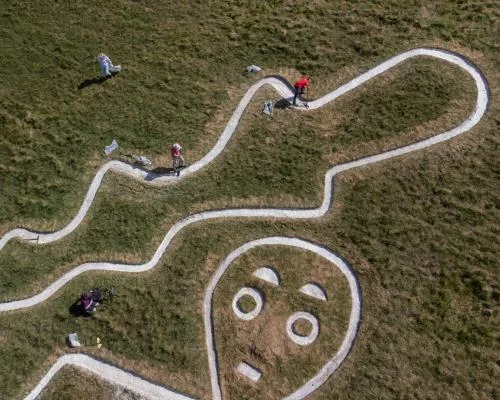
For centuries, the good people of Dorset have trekked up the side of a dizzyingly steep hill to ensure their 55-metre-tall, phallically-endowed neighbour remains visible from miles away. It’s a proper workout involving hacking out old, grubby chalk by hand and packing in fresh, white replacement material. This week, however, the job felt a bit more like a rescue mission. The changing climate is making the giant duller and distinctly more fragile than he used to be.
Luke Dawson, a lead ranger for the National Trust, has been overseeing a dedicated team of volunteers and staff currently giving the giant a much-needed scrub. He noted that they have seen algae growth starting to dull the bright white lines, which he reckons is down to the warmer, wetter conditions we’ve been having of late. Milder winters and rainier summers are basically a buffet for plant growth, and the giant is feeling the burn. Intense rainfall is also creating runoff that washes away the chalk, meaning the team is now looking at ways to retain more water in the local landscape, perhaps by encouraging scrub to grow or maintaining permanent grassland.
The giant is hundreds of years old but the modern world is certainly affecting him.
Rethinking the recipe for history
Traditionally, the rechalking happens every seven to ten years, with the last major spruce-up occurring in 2019. Because the hill is so steep, the old way of simply tamping dry chalk into the ground just isn’t holding up as well as it used to. This time, the team is experimenting with a new, messy approach. They are mixing 17 tonnes of chalk with water to create a thick, sticky putty that hopefully clings to the chalky hillside far better than the dry stuff ever did.
It’s not just the materials changing; it’s the pace of work too. With the current warm weather, the rangers have had to get a bit creative to stop the volunteers from wilting. Gone are the long shifts; instead, they are working in 20-minute bursts followed by a break in the shade of large gazebos. Lunch is being kept sensible, featuring sandwiches from the local pub and plenty of walnut and lemon cake. They’ve even had to ban chocolate, simply because the heat would turn a bar into a gloopy puddle in seconds.
A global effort for
a local icon
Don’t think for a second that this is just a village affair. A nationwide fundraising appeal earlier this year smashed its £330,000 target in a mere 60 days. Contributions poured in from every corner of the UK, with some even arriving from Australia, Japan, and Iceland. Stephen Fry, the national treasure himself, threw his weight behind the campaign, helping secure enough land around the figure to protect the wider environment.
Among the lucky donors who won the chance to join the rechalking effort is Debby van den Berg, a 51-year-old civil servant from Gouda in the Netherlands. She admitted her family were initially baffled that she’d spend her holiday vacation climbing a Dorset hill to maintain a giant with such, shall we say, prominent anatomy. She mused that while the British are often thought of as the reserved type, she doesn’t reckon a figure like the Cerne Giant would have survived the local customs in Holland. She spent her day working on the giant’s club, finding the physical labour to be a strangely special experience.
The long mystery of
the hill
Museums manager Jane Hanney-Martin, 50, who hails from the West Midlands, was also on site with a mattock in hand, scraping away vegetation. She echoed the sentiment that while lugging chalk uphill is properly hard graft, it’s worth it to keep the tradition alive. The figure has long been a source of debate for historians; some claim he represents Hercules, while others prefer the theory that he’s a crude, satirical jab at Oliver Cromwell. Recent scientific analysis commissioned in 2021 suggests he was likely carved in the late Saxon period, specifically between AD700 and AD1100.
Michael Clarke, a veteran area ranger who has spent 33 years tending to the giant, has seen four of these rechalkings come and go. He remembers the last time, when the work was done in late summer and autumn, only for the rain to immediately wash the fresh chalk away. He’s hopeful the current warm snap will help the chalk paste set properly so the giant looks pristine for the public. For now, the volunteers are taking a moment between bouts of hard labour to enjoy the view and search for the endangered Duke of Burgundy butterfly, which calls this hill home.