

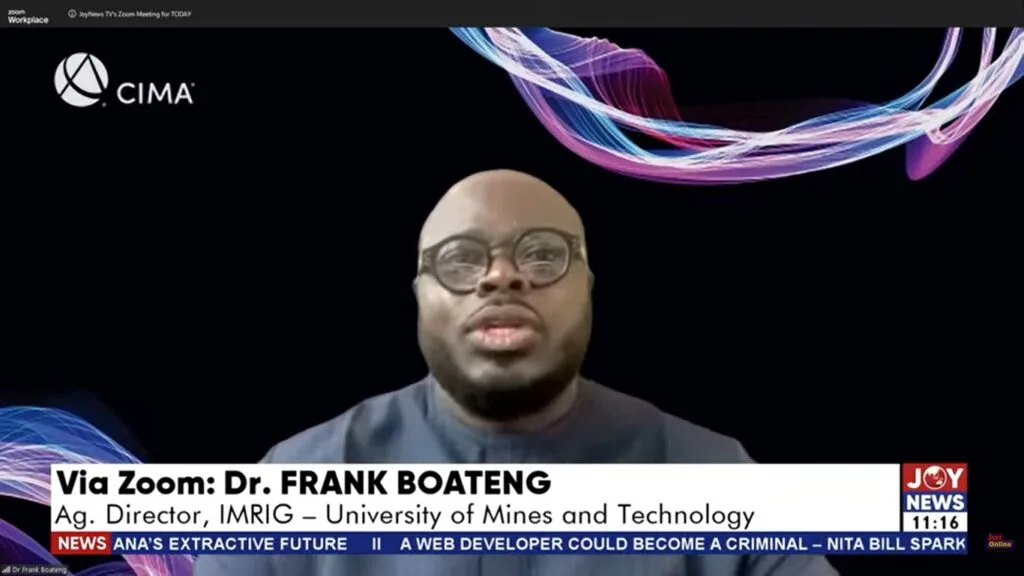
A lecturer at the University of Mines and Technology (UMaT), Dr Frank Boateng, has urged Ghana to prioritise maximising returns from its mineral resources through effective partnerships and revenue-sharing arrangements rather than pursuing the nationalisation of the mining sector. He says the country shouldn't nationalise the sector. Instead, it should focus on how to derive greater value from the rents and royalties generated by mining activities. Speaking during a high-level discussion on “To Nationalise or Transform? Rethinking Ghana’s Approach to Mining, Oil and Critical Minerals” in Accra on Tuesday, May 26, organised by Joy Business, Dr Boateng argued that the country's immediate focus should be on how to benefit more from its mineral resources.
Dr Frank Boateng is a lecturer at UMaT, where he's been teaching for several years. He has a deep understanding of the mining sector and has written extensively on the topic. His comments come amid growing public debate over the future of Ghana's extractive sector, as stakeholders weigh calls for greater national control of natural resources against the realities of financing and managing large-scale mining operations. They're considering the pros and cons of nationalisation.
According to Dr Boateng, Ghana has previously experimented with state ownership and control of mining operations, but those efforts were largely unsuccessful due to the enormous capital requirements associated with the industry. The sector was eventually returned to private operators, many of whom aren't foreign entities, after the State struggled to sustain the significant investments needed to run large-scale mining operations. It's clear that the State can't handle it on its own.
“What we need to do now is be able to benefit more from our rent. And also make sure that, because of the kind of capital you need to mine, if we're in a hurry to give the mining companies to individuals to run, it will be difficult to mine,” he said.
Dr Boateng maintained that the financial demands of establishing and operating mines remain beyond the reach of most local investors, making it difficult for Ghanaians to take over existing mining assets or develop new ones without substantial external support. They can't do it alone. Rather than pursuing outright nationalisation, he advocated a stronger public-private partnership model that would enable the country to benefit from private capital, technical expertise and operational efficiency while ensuring that the State receives a fair share of the wealth generated from its natural resources. This model won't work if the State doesn't get a fair share.
The University of Mines and Technology (UMaT) is a public university located in Tarkwa, Ghana. It was established in 2001 to provide higher education in mining and related fields. The university has a strong reputation for producing graduates who are well-equipped to work in the mining industry. They're well-prepared for the workforce.
Dr Boateng's comments have sparked a debate about the future of Ghana's mining sector. Some argue that nationalisation is the only way to ensure that the country benefits from its natural resources, while others believe that public-private partnerships are the way forward. They're still discussing the best option. It's clear that Ghana needs to find a way to maximise its returns from the mining sector. The country can't afford to miss out on this opportunity.
In recent years, Ghana has taken steps to increase its revenue from the mining sector. The government has introduced new policies and regulations aimed at increasing transparency and accountability in the sector. However, more needs to be done to ensure that the country benefits from its natural resources. They don't want to leave anything on the table.
The mining sector is a significant contributor to Ghana's economy. It accounts for a substantial proportion of the country's export earnings and provides employment opportunities for thousands of people. It's a vital part of the economy. However, the sector is also facing challenges, including environmental degradation and social conflicts. They're trying to address these issues.
As Ghana looks to the future, it's clear that the mining sector will play a critical role in the country's economic development. Dr Boateng's comments highlight the need for a careful and considered approach to the sector, one that balances the need for economic growth with the need to protect the environment and ensure that local communities benefit from the sector. They can't ignore the environmental impact. They won't ignore the local communities.
Key Facts
- Dr Frank Boateng is a lecturer at the University of Mines and Technology (UMaT)
- Ghana has previously experimented with state ownership and control of mining operations
- The mining sector is a significant contributor to Ghana's economy
- The sector accounts for a substantial proportion of the country's export earnings
- The government has introduced new policies and regulations aimed at increasing transparency and accountability in the sector
Dr Boateng's comments highlight the need for Ghana to focus on maximising its returns from the mining sector. The country needs to find a way to balance the need for economic growth with the need to protect the environment and ensure that local communities benefit from the sector. As the debate continues, it's clear that Ghana has a long way to go in terms of maximising its returns from the mining sector. The country won't achieve its goals overnight. It's a complex issue that requires careful consideration. Ghana won't find a solution immediately, but it's working towards it.