

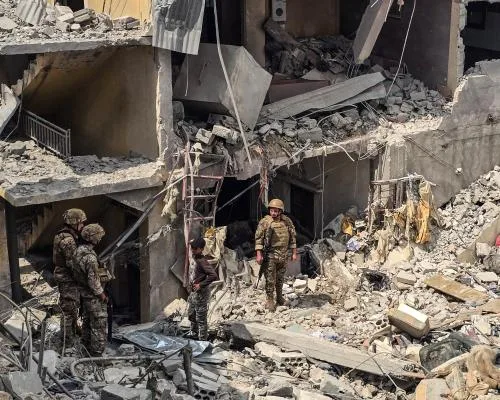
The guns in the Middle East aren't just firing; they’re getting closer. On Tuesday, the conflict reached a boiling point when Israeli troops engaged in intense, point-blank combat with Hezbollah fighters in Zawtar al-Sharqiyah. This town sits well north of the Litani river, blowing right past the supposed buffer zone that was meant to keep the peace. It’s a messy, deadly expansion that has left 31 people dead, including four children, according to the Lebanese health ministry.
"The possibility of war is low because of the enemy’s weakness, the armed forces are lying in wait with full magazines," said Mohammad Akbarzadeh, deputy political chief of the Islamic Revolutionary Guard Corps Navy.
While the IRGC is talking tough from Tehran, claiming a full-scale war with the U.S. isn’t likely, the reality on the ground feels different. Prime Minister Benjamin Netanyahu has given the green light to take control of fresh territory. He’s aiming to secure northern Israeli communities by force. For the people in the Bekaa valley, Bint Jbeil, and Maroun al-Ras, this has meant enduring over 150 targeted strikes in a single day. The destruction is relentless, and it’s effectively shredded the April ceasefire agreement that was supposed to keep everyone calm.
The situation in the Strait of Hormuz remains a proper mess. The waterway, which has been locked down since February, is still the site of a high-stakes standoff. South Korea is particularly miffed after an investigation into the HMM Namu cargo ship attack on May 4 linked missile components found on board to Iranian origins. While Seoul is summoning the Iranian ambassador to lodge a formal protest, officials there aren't yet claiming the strike was a deliberate act of war. They're just pointing at the debris and shaking their heads at the turbojet engines.
Ali Bagheri, Iran’s deputy secretary of the supreme national security council, is busy playing a game of brinkmanship in Moscow. He’s been telling anyone who will listen that unless every single issue is resolved, they’ve agreed on absolutely nothing. Negotiations with Oman regarding a new passage mechanism for ships are ongoing. Tehran seems in no rush to open the tap for global oil, which has surged back over $100 a barrel. This massive surge in oil prices is putting a severe strain on the global economy, making it harder for everyday folks to afford basics.
Away from the sea, the violence in Gaza hasn't taken a day off either. The Israel Defense Forces (IDF) have claimed the scalp of Mohammed Odeh, the head of Hamas’s armed wing. Israel says they caught him in a hideout in Gaza City just 11 days after his predecessor, Izz al-Din al-Haddad, was taken out in a similar strike. Israel’s defense minister, Israel Katz, has made it clear that anyone connected to the October 7 attacks is on a kill list. He’s also floating plans for voluntary emigration out of Gaza, promising that Hamas won't be calling the shots there for much longer.
The human cost of this mess is stretching far beyond the borders of Lebanon and Gaza. Carl Skau, the acting executive director of the UN World Food Programme, warns that 363 million people are currently facing acute hunger worldwide. A staggering 45 million of those people are going hungry directly because of the fighting in the Middle East and the resulting spike in energy prices. With the United States—traditionally the biggest donor—slashing its funding by more than half, the WFP is forced to make impossible choices. They are essentially taking food from the hungry to keep the starving alive, a grim reality not seen in decades.
Back in Washington, Donald Trump is trying to manage the chaos. He’s hosting a cabinet meeting today at the White House to discuss the Iran war. He moved the meeting from the quiet, woody retreat of Camp David because of some rain in the forecast. It’s a busy day for his team, including Tulsi Gabbard, the outgoing director of national intelligence who is set to step down by the end of June. Officials are working to see if these high-level talks can stop the violence before the entire region completely boils over.