

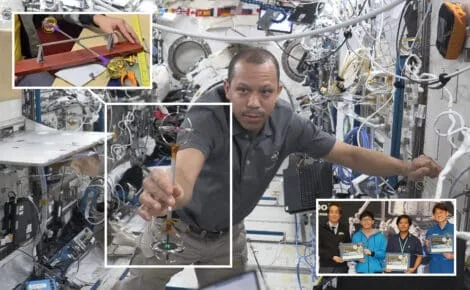
It’s not every day that three students from Rizal Technological University get their work tested 400 kilometers above the Earth. Christopher Tumamac, Ryan Andrew Doña, and Rose Ann Cezar, all third-year astrophysics students, recently saw their vision come to life when NASA astronaut Christopher Williams performed their "Double Gyroscope" experiment inside the Kibo module of the International Space Station.
The project was part of the 2025 Asian Try Zero-G (ATZG 2025) competition. Organized by the Japan Aerospace Exploration Agency (JAXA), the program is designed to get young minds in the Asia-Pacific region thinking about the practical realities of life and science in microgravity. While most of us are worried about Manila traffic, these students were busy figuring out the physics of spinning objects in a vacuum.
So, what exactly is a double gyroscope? Think of two gyroscopes attached to either end of a stick. The students wanted to see how these rotors would react to forces when there’s no gravity to pull them down. Their hypothesis was that if you spin the rotors in opposite directions, the system would essentially cancel out the movement, making the whole thing look steady and still.
The students hypothesized that when the gyroscopes spin in opposite directions, their motion may cancel each other out, causing the system to appear stable or nearly motionless.
This isn't just for show, either. PhilSA, the Philippine Space Agency, explained that this principle is used to control how satellites and spacecraft orient themselves in orbit. Without these kinds of stable systems, your GPS might stop working. A space telescope wouldn't be able to point at a star long enough to take a clear photo. By testing this with a simple stick and two rotors, the students provided a hands-on look at a concept that keeps our modern telecommunications running.
The selection process was no joke. The team had to stand out from 89 other proposals submitted across the Philippines between November 2024 and January 2025. Once their design was picked as one of the 11 finalists, it had to compete against entries from countries like Bangladesh, Australia, Japan, Malaysia, Singapore, Taiwan, Thailand, and the United Arab Emirates. For the final presentation, Christopher Tumamac and Ryan Andrew Doña flew out to the JAXA Tsukuba Space Center in Ibaraki, Japan, to present their research.
- Nov 15, 2024: Submission window opened for the ATZG 2025 competition.
- Jan 17, 2025: The deadline for student proposals nationwide.
- March 24, 2026: Astronaut Christopher Williams conducted the test aboard the ISS.
- 89: Total number of proposals submitted from the Philippines.
- 11: Total number of finalists selected by JAXA for the 2025 cycle.
Watching the live stream from the Tsukuba Space Center, the team saw their hard work float into action. Astronaut Christopher Williams performed the experiment repeatedly, spinning the devices and tracking how they behaved under zero-gravity conditions. Preliminary observations from PhilSA indicate that the real-life behavior of the gyroscopes matched what the students had predicted in their initial study.
The Philippines has been making a habit of this. Since 2022, local students have consistently earned spots as finalists in the ATZG competition. Past experiments have tackled everything from the movement of oloids—which are smooth, rounded objects—to the effectiveness of elastic resistance bands for astronauts trying to stay fit while drifting in orbit. Filipino students are becoming regular contributors to the global scientific community’s understanding of the final frontier.
This success is about building a pipeline for the next generation of aerospace engineers and scientists in the country. The team noted that the zero-gravity environment presented unique challenges. The support from PhilSA and the chance to participate in the Kibo-ABC program—a collaborative effort to maximize the use of the Japanese Experiment Module—opened doors they hadn't imagined existed.
There is something special about seeing local students go from a classroom in Mandaluyong to a live broadcast with the International Space Station. It proves that you don't need a multi-billion dollar lab to contribute to real, high-level space research. Sometimes, you just need a great idea, a well-placed gyroscope, and the guts to challenge the way things move in the dark, quiet space above our heads. The final results will be presented at the ATZG wrap-up session later this year, and the students will showcase their work to the world.