

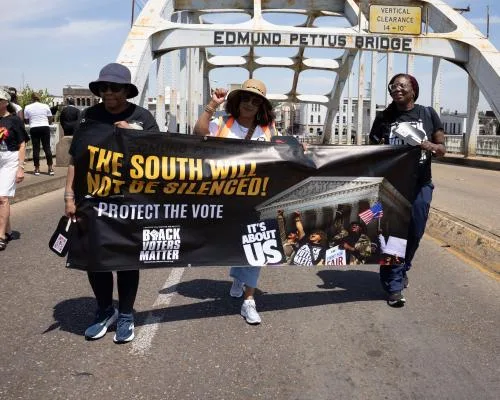
A federal court has blocked Alabama's new voting map, saying it was drawn to discriminate against Black voters. The decision, made by a panel of three federal judges, means the map won't be used in this year's midterm elections. It's a major ruling that will impact the state's elections.
The court's ruling was based on the fact that the map was drawn with the intent to discriminate against Black voters. They didn't create the map by accident - it was designed to dilute the influence of Black voters in the state. The judges found that the map was created to minimize Black voters' power.
Judge Stanley Marcus of the US court of appeals for the 11th circuit, a Bill Clinton appointee, was part of the panel that made the decision. He was joined by US district Judges Anna Manasco and Terry Moorer, who were both appointed by Donald Trump. They're the ones who decided the map wasn't fair.
The case began in 2021 when a group of Black plaintiffs sued the state over its congressional map. They argued that the map diluted the influence of Black voters in the state. The court agreed with them and ordered the state to draw a new map. The state didn't get it right the first time, so they had to try again.
The new map, which was passed in 2023, was also found to be discriminatory. The court-appointed special master ultimately drew Alabama's map, adding a second majority-Black district. This new map is more fair to Black voters.
The court wrote in its opinion: We can't see our way clear to requiring Alabamians to cast their votes in the 2026 elections under a districting plan tainted by intentional race-based discrimination.
The decision is significant because it comes after the US supreme court gutted a major provision of the Voting Rights Act in a case called Louisiana v Callais. The supreme court's ruling was seen as a major blow to voting rights. The Alabama case is the first test of the limits of that ruling. It's a crucial test, and it's going to set a precedent.
The Alabama case isn't the only one of its kind. Other states, including Tennessee and Louisiana, have also tried to redraw their congressional maps to favor Republicans. These efforts haven't gone unnoticed - they've been met with widespread outcry from Black leaders and civil rights groups. They're speaking out against the maps because they're unfair.
Tennessee implemented a new congressional map that wipes out a majority-Black congressional district based in Memphis. Louisiana is also poised to get rid of a majority-Black district, and South Carolina may follow soon after. They're all trying to change the maps to benefit Republicans.
The efforts to redraw the maps are part of a Republican-led blitz across the US south to add Republican-friendly seats ahead of this fall's midterm elections. They're trying to gain an advantage, but it's not going to be easy. The move has been criticized for resurrecting an ugly chapter in American history and intentionally denying Black voters a say in the political process. It's a move that won't be tolerated.
The case will likely be appealed to the US supreme court. If the supreme court agrees to hear the case, it could have major implications for voting rights in the US. The supreme court's decision will be crucial - it's going to impact voting rights for years to come.
The decision to block the map is a win for civil rights groups, who have been fighting against the efforts to redraw the maps. It's also a reminder that the fight for voting rights is ongoing, and that the courts will continue to play a major role in shaping the outcome. The courts are going to keep making decisions that impact voting rights.
Key Facts
- A federal court blocked Alabama's new voting map over racial discrimination
- The map was drawn to discriminate against Black voters
- The decision was made by a panel of three federal judges
- The case began in 2021 when a group of Black plaintiffs sued the state over its congressional map
- The US supreme court gutted a major provision of the Voting Rights Act in a case called Louisiana v Callais