

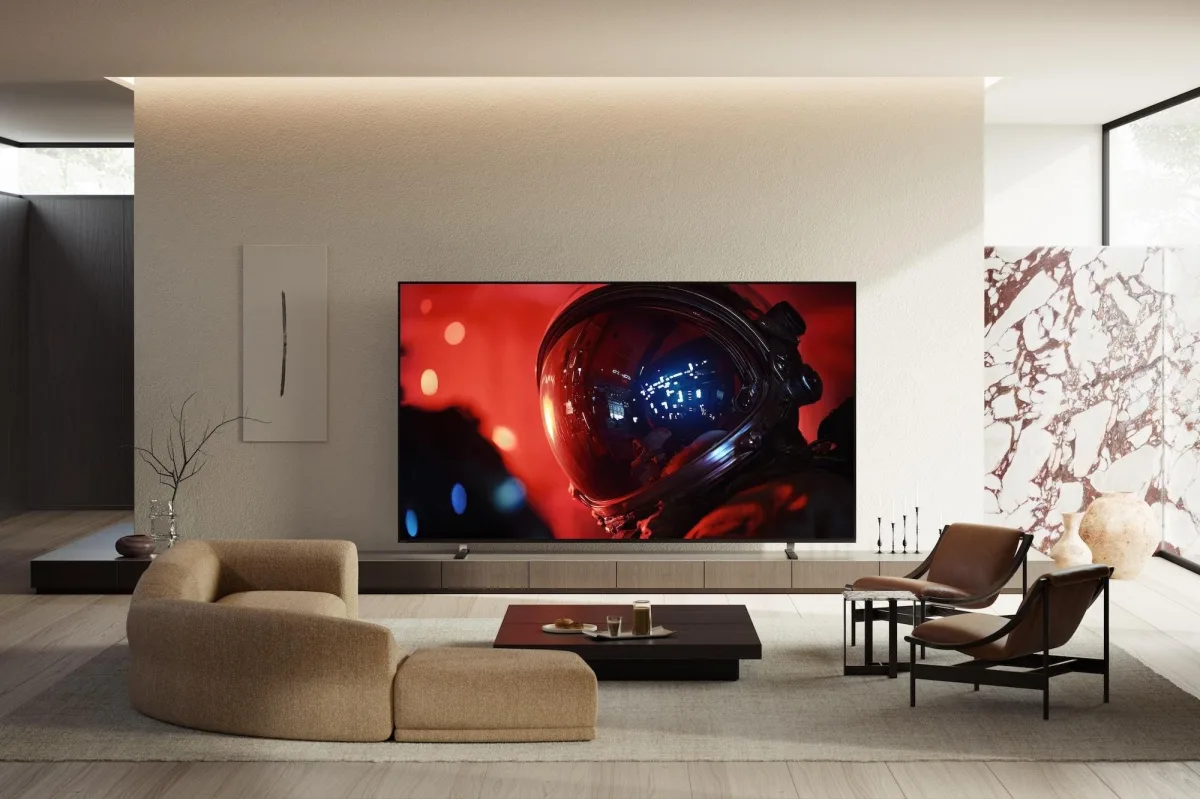
Sony is officially done playing games with its new True RGB TV range, pulling back the curtain on its first consumer models after more than a year of hints and tech demonstrations. You aren't just getting one new set here; Sony is launching two distinct series, the Bravia 9 II and the Bravia 7 II. They're aiming to capture both the ultra-wealthy market and the more budget-conscious enthusiast.
What makes these screens special is the use of actual red, green, and blue LEDs to light the panel. Most TVs you see at the shop right now use blue or white lights pushed through filters or layers of tiny crystals. This True RGB approach is designed to produce wider color ranges and much higher brightness levels. Sony claims these sets can push nearly 4,000 nits of brightness, which is serious power for a home display.
The most fascinating piece of tech hidden inside these frames is a specialized system that keeps an eye on the TV's internal temperature. Heat can seriously mess with color accuracy, making your favorite movies look slightly off-tone after an hour of binge-watching. Sony's new sensors constantly adjust for these shifts in real-time. This provides a performance advantage that lets Sony leapfrog the competition in picture quality.
They have also introduced a clever power-distribution trick. The TV detects the dark parts of a scene and moves power away from those spots, funneling it instead to the brightest highlights on the screen. In live demonstrations, Sony showed that its Bravia 9 II models run nearly three times as efficiently as competing RGB LED screens from TCL while hitting those massive brightness peaks.
If you opt for the top-tier Bravia 9 II, you’re getting the new 'Immersive Black Screen Pro' technology. This is a mix of anti-glare and anti-reflection layers designed to keep your screen looking deep and dark even when your living room is bathed in midday sun. It's a distinct approach compared to what Samsung or LG currently offer. They're utilizing a patent-pending nano-structural layer to keep colors accurate even when you're sitting way off to the side of the couch.
For those who hate the look of tangled wires, the Bravia 9 II design is a major win. The TV sits on a centrally mounted base plate attached to a transparent neck. This uses special lenses to effectively make your cables invisible. It’s clean, it’s sleek, and it’s the kind of high-end industrial design that justifies the price tag for people who care about how their home looks when the screen is off.
"Sony focus on using the technology to deliver authentic and accurate pictures based on those achieved by the brand’s professional mastering monitor division."
Sony clearly realized that a 115-inch screen deserves better than a pathetic flat-panel speaker. On the 65, 75, and 85-inch Bravia 9 II units, they have packed in a new array of mid-range drivers and subwoofers near the top of the rear panel. By moving these components to the top half of the chassis, the sound projects from a 'head-height' position. This makes it feel like voices and action are coming directly from the center of the screen rather than from somewhere down at your feet.
Even if you don't go for the flagship, both the 9 II and 7 II models include a virtualizer system that mimics a 5.1.4 speaker setup. It uses the physics of how your ears process sound to create the illusion of speakers above you. This expands regular stereo sound into something that feels much wider and more atmospheric without needing to clutter your floor with extra speakers.
Sony is adding a UI feature called 'My Cinema' that lets you save specific macro settings for different viewing environments. If you want one setting for a bright daytime sports watch and another for a moody, dim room, you can map these to specific inputs like your cable box or streaming device. It takes the guesswork out of calibrating your TV, giving users a simple, visual way to ensure they're getting exactly the picture they want every single time they switch on the screen.