

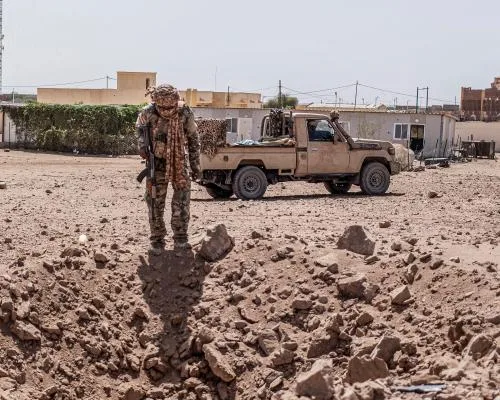
Mali's armed forces, supported by Russian mercenaries, have launched airstrikes targeting a rebel alliance of Islamist extremists and Tuareg separatists as the ruling junta struggles to maintain its hold on power in the unstable west African country. This sharp escalation comes after the rebels launched a surprise offensive across much of Mali in late April, capturing key towns and inflicting significant casualties on government forces.
The airstrikes have targeted the key northern town of Kidal, which was lost when the rebels launched their offensive. Warplanes have also targeted other areas, while Russian-piloted and supplied military helicopters have protected convoys or airlifted supplies to remote outposts where Mali's army has mounted efforts to reimpose government authority. The rebel offensive has been marked by ambushes, car bombs, drones, and raids, all of which have taken a heavy toll on government forces and their Russian auxiliaries.
The defence minister, Sadio Camara, died in a suicide attack on his residence in the garrison town of Kati, 15km north-west of the capital, Bamako. The head of military intelligence was also killed in the attack. Other attacks have hit Mali's international airport, while rebels seized control of Kidal after soldiers fled and a force of Russian mercenaries surrendered. The defeat reversed a key symbolic victory won by the junta in Mali three years ago.
Nina Wilén, the Africa director at the Egmont Institute, an international relations thinktank in Brussels, says they're fighting back. There hasn't been a mutiny or counter-coup, she notes. That doesn't mean it won't happen, but they're still fighting, and that's something to note.
The rebel coalition, which unites the al-Qaida-linked group Jama'at Nusrat al-Islam wal-Muslimin (JNIM) with the Tuareg-dominated rebel group Azawad Liberation Front (FLA), has continued its military operations, striking dozens of military posts in the centre and north of Mali. They're enforcing a strict blockade on Bamako, which has had a severe impact on the city. There's been a wave of arrests reported, and the city's under tight curfew.
Despite the scale of the rebellion, the ruling military junta has shown some resilience after being badly shaken by the wave of rebel attacks. The junta's leader, Assimi Goïta, has survived an attack on his home, and the government has claimed that it's "neutralised" several hundred "terrorists" since the April attacks. However, the humanitarian situation in Mali is dire, with hundreds of civilians killed in recent weeks, mostly in attacks against villages in the central Mopti region claimed by JNIM.
The UN secretary-general, António Guterres, has warned that the worsening security situation in Mali and across the whole of Africa's Sahel region is driving a humanitarian emergency marked by growing violence against civilians, widespread displacement, and growing food insecurity. Guterres has called for dialogue and collaboration among countries in the region to address "violent extremism and terrorism".
Key Facts
- Mali's armed forces have launched airstrikes against a rebel alliance of Islamist extremists and Tuareg separatists.
- The rebel alliance has captured key towns, including Kidal, and inflicted significant casualties on government forces.
- The defence minister, Sadio Camara, was killed in a suicide attack on his residence.
- The head of military intelligence was also killed in the attack.
- The rebel coalition has continued its military operations, striking dozens of military posts and enforcing a strict blockade on Bamako.
The situation in Mali is complex, with a historically nomadic people, the Tuaregs, waging an armed struggle for decades against marginalisation. Islamic militancy has surged across the Sahel over the last 20 years, fuelled by bitter competition over scant resources, sectarian tensions, decades of conflict that have left huge numbers of weapons, and the failure of governments to provide basic services or security. Last year, nearly 70% of deaths from terrorism globally occurred in only five countries, three of which were in the Sahel.
The surge in militant activity can't be attributed to a single factor. However, one major factor is the brutal counterinsurgency tactics systematically employed by armed forces and Russian mercenaries across the region. The Africa Corps, as the Russian mercenaries are known, have been withdrawing from outlying posts to reinforce the defences of Bamako. Their primary purpose is to protect the regime, and they've discharged that duty, with Goïta still in power and Bamako still ruled by the junta.
The role of external actors, such as Russian mercenaries, is crucial in this context. The Kremlin first dispatched mercenaries to Mali in 2021, in a move seen as an attempt to expand its influence in the region. The use of mercenaries has raised concerns about the humanitarian impact of the conflict, as well as the potential for further destabilisation in the region.
As the situation in Mali continues to unfold, it's clear that the humanitarian situation is dire, and the need for a sustainable solution is urgent. The international community must work together to address the root causes of the conflict, including poverty, marginalisation, and lack of access to basic services. Only then can they hope to bring peace and stability to the region.
The conflict in Mali has had a significant impact on the regional security situation. The Sahel region, which spans across several countries in west Africa, has seen a surge in militant activity in recent years. The region's porous borders, combined with the lack of effective governance and security, have created a fertile ground for militant groups to operate. They're taking advantage of the situation, and it's won't be easy to stop them.
The situation in Mali is complex and multifaceted, with a range of factors contributing to the surge in militant activity. The use of Russian mercenaries, the brutal counterinsurgency tactics, and the lack of effective governance and security have all played a role in destabilising the region. As the international community works to address the root causes of the conflict, it's essential to consider the regional security implications and work towards a sustainable solution that brings peace and stability to the region. The international community can't afford to wait, as the situation is dire, and they won't be able to reverse the damage if they don't act soon.