

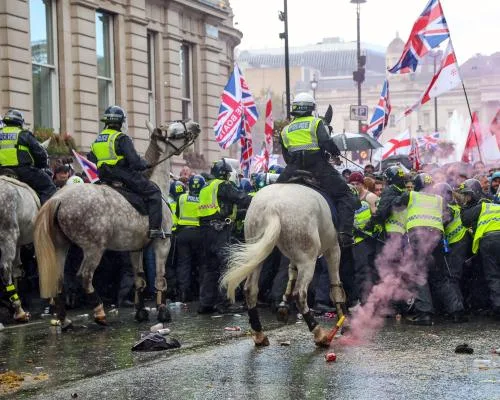
The UK has blocked 11 foreign far-right activists from entering the country ahead of a rally by Tommy Robinson supporters, a move that highlights the government's efforts to prevent the spread of hatred and division. The rally, which is set to take place on Saturday, has sparked concern among community leaders and politicians, who've accused the event's organizers of peddling hatred and division.
The blocked activists include Valentina Gomez, a US-based anti-Islam influencer, and Eva Vlaardingerbroek, a Dutch influencer, as well as Dominik Tarczyński, a Polish politician and MEP. The government deemed their presence could pose a threat to public order and safety, so they're not allowed to enter the UK.
The rally, which is being promoted by Tommy Robinson, whose real name is Stephen Yaxley-Lennon, is expected to attract thousands of supporters. It's been organized to call for a general election. This event marks a pivot by Robinson towards encouraging his supporters to get involved in political campaigning and voting. Speakers at the event will include Siobhan Whyte, the mother of Rhiannon Whyte, a woman who was stabbed to death by an asylum seeker.
The archbishop of Canterbury, Sarah Mullally, has spoken out against the rally, urging people to choose hope and unity over hatred and division. She says the country is more divided than ever, but there's far more that connects people than divides them. Mullally's comments were echoed by Rabbi Jonathan Wittenberg, a leading voice in interfaith dialogue, who says he takes hope from the solidarity he's received from Muslims and Christians during a spate of attacks on Jewish people and sites in London.
The UK government has also announced that it will be using live facial recognition technology for the first time as part of a protest policing operation. This technology will be used to identify and track individuals who may be planning to cause violence or disorder during the rally. The government has imposed Public Order Act conditions on a big pro-Palestinian march and the self-styled Unite the Kingdom event promoted by Robinson.
When we watch the news or scroll through our phones, it can feel as though our country is more divided than ever. But that's not the whole story. When I visit churches and communities, I see people serving one another and looking out for those in need. This gives me hope.
- Sarah Mullally, Archbishop of Canterbury
The rally has sparked a heated debate over the role of far-right extremism in the UK. Politicians and community leaders have accused the event's organizers of promoting hatred and division, while others have defended the right to free speech and peaceful protest. The event is set to take place on the same day as a large pro-Palestinian march, which is expected to attract tens of thousands of people.
The UK government has said that it will take a zero-tolerance approach to hate and violence during the rally. The home secretary, Shabana Mahmood, says the police will have the power to deploy a range of measures to keep people safe, including the use of live facial recognition technology. The government will be working closely with community leaders and organizations to promote unity and cohesion.
As the rally approaches, there are concerns over the potential for violence and disorder. The police say they'll be taking a robust approach to policing the event, and anyone who seeks to cause trouble will face the full force of the law. The government has also urged people to report any instances of hate or extremism to the authorities.
The rally is set to take place on Saturday, and it's expected to be one of the busiest days of the year for policing in London. Many people are expected to attend the pro-Palestinian march, while there will also be a presence by anti-fascist protesters organized by Stand Up to Racism. The police say they're prepared for all eventualities, and they'll do everything in their power to keep people safe.
Key Facts
- 11 foreign far-right activists have been barred from entering the UK
- The rally is set to take place on Saturday
- The event is expected to attract thousands of supporters
- The government has imposed Public Order Act conditions on the rally
- Live facial recognition technology will be used for the first time as part of a protest policing operation
The UK government's decision to block the far-right activists from entering the country is a significant move because it shows the government's commitment to protecting the public and promoting unity and cohesion. The government won't tolerate hatred and division, and it's taking steps to prevent them. As the rally approaches, the government will be taking a robust approach to policing the event and keeping people safe. The outcome of the event is uncertain, but the government's approach is clear - it won't allow hatred and violence to spread.